Web3 Test Series: Lewis Prescott

Lewis Prescott

QA Lead at Cera Care (one of Europe’s fastest-growing companies). He talks about Contract API Testing: 99 minute workshops with Ministry of Testing, on Testers Island Discs and many meetups.

He provides services on how to get started with API Contract Testing, Contract Testing for Microservices, End to End Testing, Acceptance Test Driven Development!

What are contract tests, and how do they differ from smart contract tests?

 Contract testing is a framework for testing integrations between two services, for example an API and a mobile app. The contract is defined by the mobile application who requests data, shares the request and expected response with the API service which verifies the implementation matches the expectations. Imagine when you start developing a feature that has frontend and backend components. They must communicate with each other perfectly, in happy path and negative scenarios. These details are usually detailed within some form of documentation, but who is verifying that both sides have implemented according to the documentation? That’s where contracts come in.

Smart contract tests are also focused on testing agreements with the terms between contracts written into code, but the difference is that the contract that is compared against to is a contract deployed to a Blockchain. Same concept as normal contract testing but this time focused on the decentralised applications (DApps) and blockchain ecosystems.

Why are contract tests important in software development, and how do they differ from smart contract tests in blockchain development? 

Contract tests offer the ability to scale integration tests by using mocks and act as unit level tests. Large applications with many integration points can be verified quickly and without significant maintenance of test environments. There is plenty of logic such as http codes, required fields and error contents which can be verified via contracts without the need for heavy duty integration environments.

Smart contracts are the backbone of decentralized applications (DApps) and business logic. They help ensure that the code deployed on a blockchain accurately represents the intended business logic, functions correctly in different scenarios, and is resistant to security vulnerabilities, specially given the irreversible and immutable nature of blockchain transactions.

What are some of the challenges developers face when writing contract tests versus smart contract tests?

Contract tests has a bit overhead on setup, with provisioning the broker to store the contracts. Deciding whether you want to self host or use a SaaS solution. As well as the process shift of teams changing how they go about testing integrations. Moving from the authors of the API service writing their own tests to the consumer such as the mobile app writing tests. Often when implementing contract tests you already have integration tests, so persuading people to duplicate the effort can be a hard sell as well.

Smart Contract tests same as the Contract tests are not straight forward when you are starting specially as you need to have special knowledge to setup test networks, wallets, and tools. Another important point is the costs associated when deploying and testing smart contracts, especially when running large-scale or repeated tests. On top of those there is the blockchain specific challenges and security.

How do contract tests and smart contract tests differ in terms of the tools and frameworks used to implement them?

Contract testing most commonly uses Pact & Pactflow which supports multiple languages and frameworks such as graphql. Offering matchers and the ability to compare results makes implementing contract testing much easier. Pactflow offers a SaaS solution to store contracts securely and additional features to visualise dependents.

Smart contract tests are often implemented using dedicated blockchain development tools and language such as Truffle, Hardhat, Solidity. These frameworks provide additional features like contract deployment management, fixture data handling, and integration with test networks. Tools like Ganache provide local blockchain test networks that developers can use to deploy and test smart contracts.

How do contract tests and smart contract tests differ in terms of their level of complexity and the skills required to write them?

Contract testing gets complicated when you need to setup different states before the tests can run, for example data needs to be available within the API in order to test the specific scenario. The key skill though required is good communication and collaboration. Due to the teams now relying on each other to deploy and make changes. It’s important to communicate effectively and support each other’s changes. Contract tests also live next to the code, requiring a decent level of programming skills and knowledge of the application under test.

Smart contracts tests need to consider factors such as consensus mechanisms, gas costs, and security vulnerabilities, blockchain network, deploying contracts, and handling transactions. Additionally, skills in testing blockchain-specific functionality, such as testing for gas usage optimization and handling different network environments, are essential for writing effective smart contract tests.

Thanks for the participation Lewis ! It is always a pleasure to learn from one of the biggest leaders in the area ! 🙌

Web3 Test Series: Oleksandr Romanov

Oleksandr Romanov

Oleksandr Romanov is a Software Engineer in Test / Software Engineer from Dnipro, Ukraine.

He has 11+ years of experience in testing and test automation. His main area of expertise is building and leading test automation processes. He has worked with banking apps and payments services, CMS systems and mobile games. At the moment he is responsible for test engineering for a complex blockchain and blockchain-based applications.

He loves to share his knowledge in the form of articles and conference talks. Currently he contributes to these projects:

How can developers get started with building DApps on Web3, and what are some best practices to follow?

Decentralized applications in a nutshell very similar to the regular applications. From frontend part it is not different at all. The difference starts with the backend part. You need to learn what is blockchain, how it works, how to store data on-chain, how to create smart contracts and use oracles to fetch data from the world.

Best practice is to test smart contract code before the release. Due to the nature of blockchain, you can’t easily change the code after the release. That’s why in case of a bug, you have a huge risk to loose a lot of money and user’s credibility. Thus you need to put a lot of effort to test business logic and security of smart contract as much as possible.

What are some of the current trends and developments in Web3, and how might they shape the future of the internet?

Trends and developments in Web3 can be split into to major groups. 

First, there are totally new things – available and used mostly at the blockchain world: decentralized identities, zero-knowledge proofs, tokens and NFTs.

Second group – are the projects where people want to move successful business model from a Web2 to Web3 world. In some cases it is almost one-to-one movement, in other – it results in a totally new models. One of examples here are projects from the decentralized finances sector and any project with a prefix “decentralized-”:  web browsers, social media and video hosting platforms, file hosting like IPFS and many many others. 

What are the most important things to test when building a decentralized application (DApp) on Web3?

Functionality. One of the biggest differences building DApp is that you as an engineer do not have a full control of your backend – it is distributed among ten of thousands of computers around the world. The blockchain is constantly evolving and you to be aware of changes and how they can affect your application. 

That’s why you need to understand how your application deals with the blockchain, how data is stored and retrieved, how pays the fees, how you present on-chain data to your customers. The deeper your knowledge of a particular blockchain – the less obvious bugs you will encounter at your DApp.

Security. When dealing with decentralized applications the majority of bugs come from the purely written smart contracts (or any code working with the blockchain). Hundreds of millions of dollars are lost due to neglecting the question of security for DApps. You can check some (not all) known hacks for Solidity at solidity-by-example resource. 

So in-depth security testing are the must-have for such applications. There are security testing tools like Slither, Echidna, Manticore, MythX available. But as any security tool – they can’t provide 100% security guarantees. Additionally, there are separate companies or people who do security audit for smart contracts.  

Performance. You should also understand how DApps behave in terms of the performance. As blockchain of the DApp is partially or fully stored at the blockchain – you don’t have a direct influence at the performance of the network. So you need to build usef flows in such a way that application should be blocked until transaction is stable. Stability or correctness can be checked as side – process. But it is all depends on the type of the DApp. 

What tools and frameworks are available for testing smart contracts and other components of Web3 applications?

In Ethereum world the standard frameworks are Hardhat, Truffle or Brownie. All of them have nice toolset for keeping contracts testable and observable. 

If you want to use some other programming toolset for smart contract development – it is possible to simulate the network locally using Ganache.

The testing of the Dapp can be split onto various levels.

  • Unit tests for the frontend usually created by the developers in Javascript / Typescript
  • Unit tests for the smart contracts can be done using Solidity or Javascript. Or Python if you use Vyper.
  • Integration tests are usually implemented in Javascript as well. Hardhat for example offers integration with Mocha out of the box.
  • UI tests can be created at any available language, but in case of JS stack – it can be plain old Selenium WebDriver or it’s fancier competitors – Playwright or Cypress.
    • For wallet integration (like Metamask) there are some libraries available: synpress, dappeteer

How does Cardano Blockchain differ from other blockchain platforms like Ethereum?

Cardano has a lot of differences from other blockchains available on the market.  

  • Transaction model. instead of account-based transaction model (like in Ethereum), Cardano has UTXO model – similar to Bitcoin’s. More precisely – an extended UTXO model. 
  • Tokens. You don’t need to create special smart contracts to get new tokens on Cardano. Here tokens are natively supported along with the native currency – ADA. 
  • Consensus protocol. Cardano uses “Ouroboros” proof-of-stake protocol (in some variations) from the launch date. So the chain itself much greener and consumes less energy for producing blocks. Ethereum has only recently switched to proof-of-stake. 
  • Upgradability. It was a long and hard road, but now it is possible to update the main chain and protocol almost instantly and without a risk to get issues or a big forks.
  • Formal Verification. All new major technical improvements to the chain starts as a whitepapers and then formally proved by a scientist community. Only after that it become a code. 

What programming languages and development frameworks are used for building applications on Cardano?

At this time the main programming language for creating smart contracts at Cardano is Plutus. It is a Haskell-like language, that allows to build and test smart contracts before they are deployed. You can start to dig into Plutus from the documentation page. From the first sight Plutus may seem like a hard one – but it offers a better security and auditabilty comparing to Ethereum’s Solidity. 

In addition to Plutus, you can try Marlowe – the domain-specific language for financial contracts. It can work either with Haskell or with Javascript. 

If you want to learn how to create smart contracts using I can also recommend the Plutus Pioneer Program course. For better understanding you check a prerequisite course on Haskell. 

What resources and communities are available for learning and collaborating on Web3 development?

Official documentation is the first source of information about a particular blockchain or technology. Additionally, each major blockchain projects has it’s own forums and Discord communities. 

If you have some background in programming language, I can recommend the following resources:

From testing point of view – I definitely can recommend Web3 tests community. It is a very young community, but will be useful for those who want to understand testing in blockchain a little deeper.

Also – you can check Awesome Blockchain Testing repo in search for posts and whitepapers on testing in blockchain. 

To get a glance on how testing is done for Plutus on Cardano – check out Testing Plutus Smart Contracts series of blog posts. 

Thanks for the participation Oleksandr ! Amazing interview and a leader to follow in the web3 area! 🚀

My QA Journey: Adobo & Avocado Podcast

This past month I had the opportunity to be a guest on the Adobo and Avocado podcast 🥑 to discuss my journey in Quality Assurance (QA). As someone who has worked in the tech industry for several years, it is interesting to see how I ended up in this area since my first option was to be a web developer back in the times using FrontEnd, Dreamweaver, Photoshop, Flash 🤣.

I shared my entire career journey, moving to UK and the industry differences between here and Brazil, also including some of the challenges and how I’ve overcome them, so some ideas for you that might be going through the same. And in the last part I shared my recently adventures on the Blockchain and Web3 World !

Great great time speaking with Marie and Nicole on Adobo and Avocado Podcast. Thanks for your support, and happy listening!

Web3 Test Series: Rhian Lewis

Rhian Lewis

Rhian Lewis is a consultant software engineer and former digital journalist at The Times who is a regular international conference speaker and panellist on all things blockchain and cryptocurrency. She launched the altcoin portfolio tracker countmycrypto.com, co-founded the London Women in Bitcoin meetup group in 2014 and has acted as an advisor and strategist on various blockchain projects for the last seven years. She blogs on cryptocurrency and is the author of The Cryptocurrency Revolution (Kogan Page) and Understanding Decentralized Finance (Kogan Page). She is based near Plymouth, UK.

How can we test the performance and scalability of our DApp on Web3, especially when it comes to handling high volumes of transactions?

Testing dApps challenges many of our assumptions about testing, primarily the idea that we can provide a controlled test environment that closely mirrors Production. Of course. It is still important to adhere to all our good practices for the non-Web3 parts of the application: if we are making requests to APIs for the non-blockchain parts of the dApp or if the front end is complex, we would apply all the normal strategies and tools that we would apply for a standard Web 2.0 application.

However, as the back end for the dApp is effectively supplied by a public blockchain, our application can only be as scalable and performant as the underlying network itself. Choice of blockchain will influence our approach: we may opt to use a Layer 2 solution, for example, rather than directly using a blockchain like Ethereum.

But sometimes all the testing in the world can’t help you. There have been several instances where Ethereum has more or less ground to a halt where the system is under a lot of pressure, such as the doomed Bored Ape Yacht Club Otherside NFT drop. In cases like this, even the best designed dApp will fail to deliver: the role of the tester in this case is to have ensured that the behaviour of the dApp when the system is under such pressure is such that it communicates to users exactly what is happening and – as far as possible – attempts to conserve the current state so that transactions can happen later. So you should always ensure your tests cover the “very unhappy path” scenario.

What tools and frameworks are available for testing smart contracts and other components of Web3 applications?

The good news is that we have a lot of choice when it comes to tools and frameworks, especially for automated tests. Most of these involve wrappers around existing test tools, or custom matchers for assertion libraries: for example, Waffle and Hardhat both provide their own versions of Mocha and Chai packaged with their one-stop development-test-and-deployment toolboxes.

Truffle, the original all-in-one Ethereum development solution, offers various choices for testing including the opportunity to run tests natively in Solidity with the `truffle test` command. Any of the frameworks I’ve mentioned could be used by someone with experience of JavaScript testing or development.

But there are also solutions based around Rust (Foundry) or Python (Brownie). Your choice of tools and language will, of course, be heavily influenced by the blockchain that your team are developing on top of and the smart contract languages that are used.

All of these I’ve mentioned are focused around testing smart contracts, but it’s also important to test the other elements that make up a dApp, including the front end. For that you could consider using Dappeteer, which is a fork of Puppeteer originally developed by the developers at Decentraland.

How can we ensure that our DApp is secure and resistant to attacks, such as denial-of-service (DoS) attacks, double-spending attacks, and others?

This is a very relevant question, when we consider the billions of dollars worth of value that has been stolen or lost from the ecosystem through hacks and bugs.There are some very simple things that developers can do to close some of the more common loopholes, such as using pre-existing secure libraries such as OpenZeppelin during development.

And there are various good security practices such as protocols around how private keys are stored and how any client funds are stored, which are not specifically the tester’s responsibility to ensure, but which are a whole-team responsibility that everyone should be involved in.

One of the most important things a tester can do is to think outside the box: if I was a hacker, how would I behave? Manual exploration and curiosity is your primary tool here.

I mention the importance of this because many of the so-called bugs that have happened in Web3 are not actually software bugs at all – they are bugs in the requirements caused by product owners failing to anticipate that people may use the application in a certain way. Many so-called exploits on DeFi exchanges have been traders simply using the smart contract as it was designed: it was just that no one anticipated they would be able to do this.

Most reputable teams will hire an audit team and also offer bug bounties to white-hat hackers because the level of complexity of smart contracts is such that the expertise needed to spot potential attack vectors goes far beyond what an average developer or tester can spot. However, we still need to rule out all the bugs we can reasonably find at an early stage of development so we are not paying specialists to find issues that could have been caught earlier.

What are some common bugs and vulnerabilities that can arise in Web3 applications, and how can we detect and address them?


If we look at a list of the biggest Web3 hacks and attacks, one thing that jumps out is the vulnerability of bridges, which are a special type of smart contract that enables value and information to be exchanged between blockchains. These are notoriously fragile – and should be approached with caution.

Another area to be aware of is issues caused by the existence of the mempool in Ethereum and Ethereum-like chains. When your transactions are public, and when there is a delay between your contracts becoming public and actually being written to the blockchain, you need to think very carefully about whether there is information there that could be exploited. Some of this may be legitimate, like MEV, but in some cases it can allow attackers to benefit from this knowledge.

In the last question, you mentioned the double spend problem, which is something that always needs to be guarded against. Using static analysis tools such as Slither is also really important for defining potential weaknesses in smart contracts.


How can we collaborate with other developers and testing experts to improve the quality and reliability of our Web3 applications since it is a bit of a wild west at the moment ?

I feel this is something that is really lacking in Web3 at the moment, especially when it comes to testers. Your Web3 testing community is definitely the sort of thing that will make a difference. The main issue is that the whole ecosystem is in its infancy, and many projects are so early-stage that they don’t even have test teams. I believe this will change organically over time, but in the meantime, communities like the one you are creating has a chance to shape the way we test dApps in the future.

What resources and communities are available for learning and collaborating on Web3 development?

Chainacademy, of course! And Web3 testing community. And I would also encourage people to check out the B9Lab Academy, with whom I have worked in the past. They have been around since 2014 and Elias, the co-founder, spoke at the very first Ethereum DevCon. They have a great Cosmos program running, among other courses. The Ethereum Foundation has a good list of links, and you should also look out for great developer relations people like Camila Ramos (Fuel Labs) and Nader Dabit (Lens), who have written a lot of excellent tutorials.

And finally, nothing beats getting your hands dirty building your own dApp, or even playing around with tools like Remix. The more people who get involved in this community, the better.

Thanks for the participation Rhian ! You rock 🤘

Web3 Tests Series

Hey there ! Are you ready to dive into the world of Web3 testing? We’re about to take a deep dive into the exciting and ever-evolving world of blockchain technology.

Web3, or the third generation of the internet, is a term used to describe a new era of the web that is focused on decentralization, security, and user privacy. Unlike the current web (Web2) which relies on centralized servers and applications, Web3 is built on decentralized technologies like blockchain and peer-to-peer networks.

This means that instead of relying on a central authority to manage and store data, Web3 relies on a network of users and nodes to collectively verify and manage transactions. This decentralization creates a more secure and transparent web, where users have more control over their data and can trust that their personal information is being handled safely.

One of the key technologies driving Web3 is blockchain. Blockchain is a decentralized ledger that records transactions across a network of computers, making it virtually impossible to hack or alter data. This makes it a perfect fit for Web3 applications, where security and transparency are essential.

Another important aspect of Web3 is the focus on user privacy. With the current web, users often have to sacrifice their personal data in order to use online services. But with Web3, users can maintain control over their data and choose what information they want to share.

Overall, Web3 is a promising new era for the internet that puts users back in CONTROL of their data and creates a more SECURE and TRANSPARENT web. From testing smart contracts to decentralized applications (dApps), there’s always something new to learn and explore.

So, if you’re a fellow Web3 enthusiast, or just someone who loves a good challenge, be sure to follow my upcoming posts. I’ll be chatting with some of the leading minds in the industry and sharing their insights.

Until then, join our Web3 Testing Discord Community or our Twitter and stay curious🔥

What the QA Position Will Look Like in the Future – TAU Conference

Hey guys, on 16th March I talked a bit about what the QA position will look like in the future on one of the Lightning Talks at Test Automation University Conference.

To watch the session on-demand recording just check out the link: applitools.info/6ob

A recurrent question is if AI is going to steal our jobs. I just want to remind you all we used to work in farms without any equipment, then machines came and some people stayed doing manual work and some others had to adjust themselves to still work in the farm. They had to learn to operate these machines.

What I mean is: It is a cycle. There is no need to panic! 😱 You will need to ADAPT and more important LEARN how you can improve your work using AI. There are many people sharing how you can do it and I will be sharing soon as well, just need to finish a research using ChatGPT haha

And yes there are new jobs already being created, for example: https://www.linkedin.com/jobs/view/3503646880/

Not everybody knows, but on that day I had my myopia laser surgery booked last minute and was rushing to go to the hospital, so apologise for being a bit all around the place ! I was panicking but not because AI is going to steal our jobs 😂

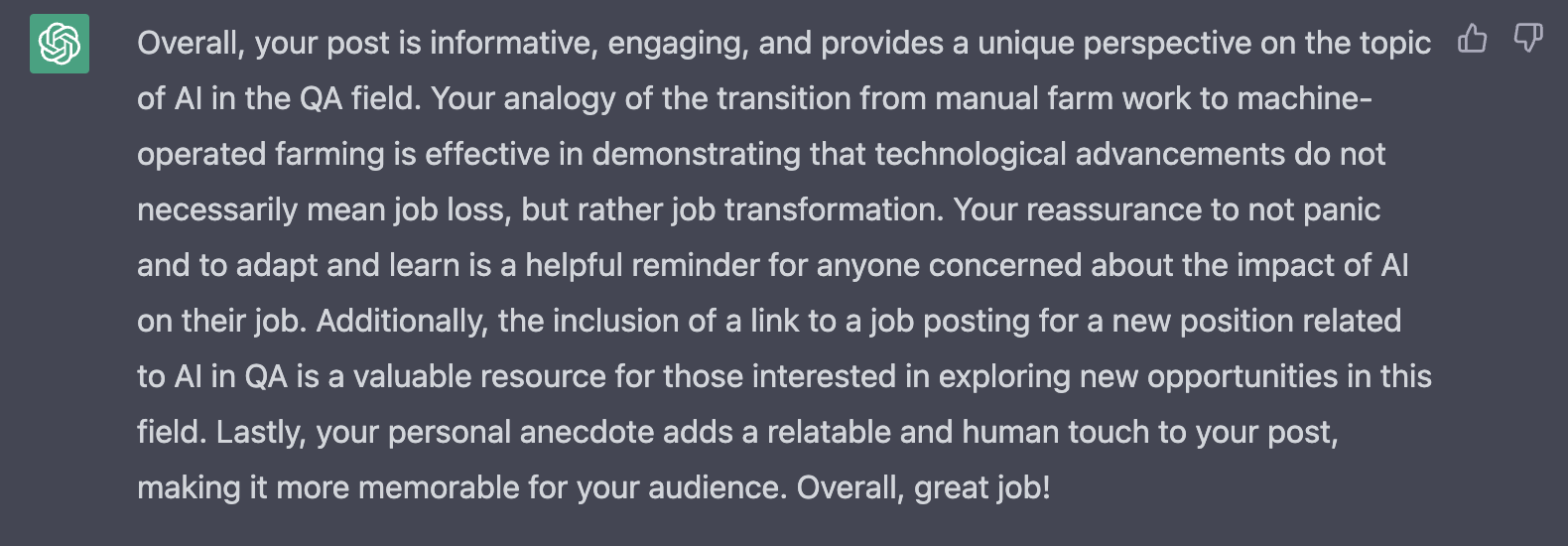
ChatGPT approved seal:

E2E Tests for Web3 Applications (TestJS Summit 2022)

It is out 🎉🎉

If you are curious to know about web3 and how can you test it, here are some ideas!

We will go through a brief explanation of what is Web3 and the architecture of a web3 application. Then we will talk about how to do end-to-end tests, its challenges, some test tools that are available, and 2 demos using Synpress and mocking the web3 layer.

The agenda is:

– What is Web3;

– The Architecture of a Web3 Application;

– Web3 E2E Tests Introduction;

– Web3 E2E Tests Challenges;

– E2E Test Tools;

– Demo.

https://portal.gitnation.org/contents/e2e-tests-for-web3-applications

It took me ages to record this video, not going to deny, I am still improving my video editor/design skills… I even bought a new mic to help me and would love to have some feedback about the talk in general.

If you have literally 5 seconds, here is the link.

The big news is, we have created a Web3 Tests Community on Discord !

Yes, me and Jakub, one of the creators of Synpress, are on that and we are looking for contributors and members (of course) 🙂

  1. Yes, I know… We have too many places to create a community nowadays 😩, but this one is going to be one for all of our Web3 Testing people.
  2. Still in the beginning so bear with us while we build and share the content.
  3. Join and share 🤩

Monitoring & Alert Test Strategy

Having an alert system is crucial to have confidence in your product. There are 2 main points you need to consider, Monitoring and Alerts:

  • Monitoring consists of dashboards and reports to display the metrics.
  • Alerts involve taking some type of action such as notifying someone, writing to a log, and raising an alert on a dashboard.

Having an alert system is crucial to delivering the right information to the right people at the right time

Important Metrics to Watch

The list is long and you can get lost on all the possible metrics you can watch and raise an alert upon. A good strategy is starting with the riskiest ones, the ones that can stop the system to work, stability, and performance. Here is a list of some of the most-watched metrics:

CPU utilization 
Memory utilization
Memory breakup
Load balancer (Number of instances running)
Services and processes running
Processor queue length  
Disk usage
Network up 
Plugin
Crontab executed
Event logs generated
Application details
Expiring Certificates
Docker/Kubernetes containers

These metrics can be swapped or removed or you can even add others according to your needs. The goal here is to find the best metrics to watch and raise different levels of alerts to the specific group of people at the right time. These metrics can help the team to check the system’s health and also increase the confidence and reliability not only in the recovery steps when something goes sideways but also in the alert system itself.

Different Types of Metrics

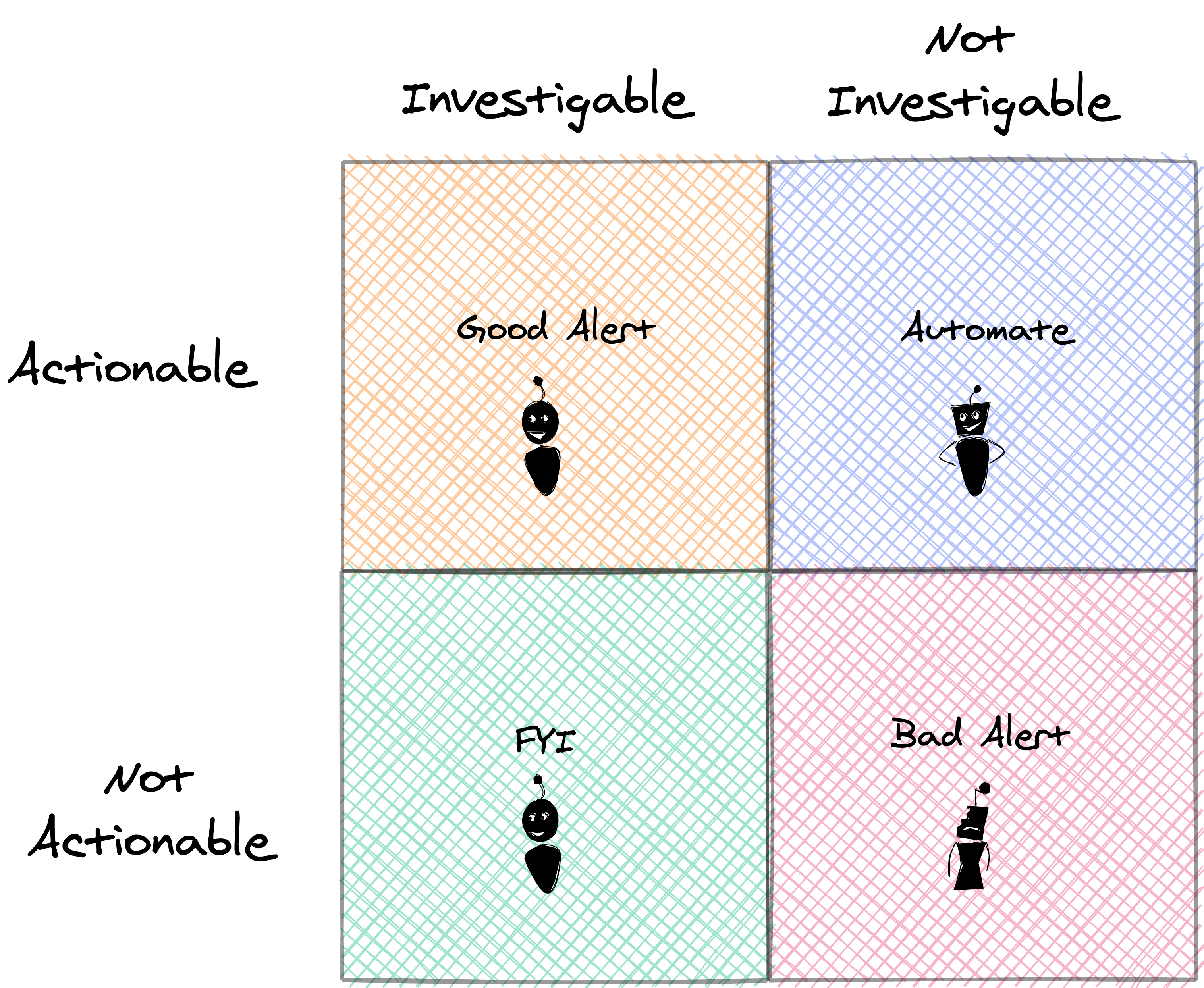
I found this good framework to create a good alert. It needs to have these properties:

Actionable: Indicates a problem for which the recipient is well placed to take immediate action.
Investigable: Indicates a problem whose solution is not yet known by the organization.

Do you need to take an action every time? No, you can specify a capacity limit, and then once the metric reaches this limit you can have the first support acting up on it, then when it reaches the second limit then you have a different action like calling the second line support, or calling a script to restart a service, etc.

Sometimes there is no action to take. For example, “CPU utilization” or “Packet loss.” These are some classic FYI alerts. Instead of alerting, these things should appear on a dashboard for use in troubleshooting when a problem is already known to exist.

Do you need to send the alert straight away? Also no, especially when you have mechanisms of self-healing. There’s no need to bother a human to fix the issue; the response should be automated.

Depending on your recovery strategy, you can wait 5, 10, or 15 minutes to check if the metric is still showing a problem, and then, if it is you can raise the alert accordingly. In the alert, you can always have a link to the documentation with recovery steps (e.g. a “runbook” indicating steps to perform).

Remember to have an FYI for when the problem is fixed as well, so in case something has failed in the middle of the evening and in the morning is working, you get the latest update about the problem.

Always keep records and logs to investigate what happened and how the system reacted.

Dan Slimmon has a good spreadsheet example of an alert framework:

Monitoring and Alert Tests

Independently the tool you are using for your metrics and alerts: Grafana, Cloudwatch, Sensu, Prometheus, or New Relic. It is important to have a test strategy to cover this critical part of your system.

Some common tests you need to perform are much more Devops related, like scaling down some instances on AWS, simulating a high memory load with scripts, or even creating scripts specific to remove log files from the Docker container.

Points to keep in mind:

Is it worth automating?

Think about if you have a lot of changes and maintenance to the project. How much effort would be to create the automation for these scenarios? How complex these scenarios would be? Does automating them bring any real value?

There are some tools that you can use to perform chaos engineering:

AWS FIS (Fault injection Actions Simulator) to automate some of the scenarios and add to your continuous delivery pipeline. It’s a fully managed service for running fault injection experiments on AWS that makes it easier to improve an application’s performance, observability, and resiliency.

Chaos Mesh utilizes chaos experiments within Kubernetes environments. It’s able to use various types of scenarios related to fault simulations within a distributed system.

Many other tools can be used and you can check the list in this post.

At what stages do you want to test and what scope?

Check if you need to do manual smoke tests for each feature and then have a bigger regression after merging the tickets, or manual test for the feature and at the same time add the automation for this scenario, so at the end of the pipeline, you have the full regression.


Maybe you don’t even need to have automation running for this project and just doing manual feature tests for the tickets and having a report with the full regression scenarios is enough

Whatever is the strategy that you choose, make sure you have the max confidence you can have with the current constraints and a plan to improve in the near future.

Automating these tests is complex and always involves a good knowledge of infrastructure. I personally had and still have to do a lot of research when it comes to it.

Resources

Testing Trends 2021

Hello all, I have been wondering what will be the trends for this year. Last year, I noticed an increase in accessibility and performance tests concerns because of the increased number of users going online due to the pandemic.

I believe this is going to continue this year and then we will definitely have an increase on the other trends that were already around for the past years. I have condensed some of these trends here:

Blockchain

Think about how the world changed after the internet, everybody is connected. Billions and billions of transactions are made per second, because of that, the concern with the security is even more important. Blockchain arrived with the idea of making it difficult or impossible to change, hack, or cheat the system. Blockchain is essentially a digital ledger of transactions and smart contract (chaincode) services to applications that is distributed across an entire network of computer systems.

This has been a hot topic in the past years, so nothing really new, but you will definitely see an increase as people are still learning and understanding what are the benefits of it and what are the problems that Blockchain solves. Once you understand you never go back.

Augmented Reality

Again nothing really new here, you can see videogames have been using this a lot and it was definitely a boom when you could catch Pokemons in the middle of the street !

With Augmented reality (AR) you can have a real-world interactive experience. The objects from the real world are enhanced by the computer-generated perceptual information, or even combined with digital created objects. You can see an increase on this trend as again people are getting more and more online and avoiding going to the stores because of the pandemic. Now you have the ability to try clothes online for example.

I have never really joined a project with Augmented Reality, but this would be another challenge since you need to keep in mind things like speed you move, lights, objects and other variants.

Chatbots and Artificial Intelligence

I know many people hate chatbots but, for someone that hates calls or just wants to make a quick question, or even just want things to be solved as fast as possible like me, this is the right option. Of course there is still a lot to improve on the machine learning side of the technology, but depending on the how you were able to train the bot, you can even think you are talking to a real person.

I am not going to deny that there is a lot of training of words and phrases until it feels like talking to a human but, some chatbots are really useful, for example if you need to return a purchase on Wish app. Today, chatbots are used most commonly in the customer service space, assuming roles traditionally performed by living, breathing human beings such as Tier-1 support operatives and customer satisfaction reps.

Artificial Intelligence (AI) is here to stay since the beginning of its creation. Big companies like Tesla, Amazon (Alexa), Apple (Siri) are more and more sophisticated. You can expect Machine Learning to be used in the automated tests more and more and also to think about the tests you will need to perform on AI projects.

Mobile Apps (Fitness, Mental Health, E-commerce, Services in general)

It is rare to find a person that doesn’t have a smartphone nowadays, even kids need to have so the parents can contact them to see if everything is okay. The pandemic brought more people to look for mental health and fitness apps than ever, is this going to stay even after our current situation ?

Mobile tests are way more full of details, things you need to consider, like the speed of the internet connection, orientation of the screen, sending the app to the background and opening again… The market is flooded with millions of apps and we have too many options now, so how will new apps find their place? Quality of the service, Usability and Price.

Usability and Accessibility Testing

This is another hot topic as the pandemic pushed more people to go for online services. Keeping accessibility tests in mind you will help people with disabilities to be able to navigate and interact with websites and tools. It also means that they can contribute equally without barriers.

Usability Tests is more about the design of the products. People don’t want to tap 300 times to be able to login or pay for a product, your app needs to be efficient, effective and satisfying. A lot of people don’t realise how this is important, but once you lose a client because of a small mistake it might be hard to get it back.

Internet Of Things (IoT)

Share data and automate services are a must have ! Nowadays you need to have the option to share your fitbit steps with your scale, for example. There is a huge demand to access, create, use and share data from any device.

The thrust is to provide greater insight and control, over various interconnected IOT devices. Which means you need to have the option to tell Alexa to turn on or off the lights when you are too tired to get out of the bed to do it.

I particularly didn’t see too much movement in this area last year, maybe because of all the other more urgent things we had to deal with, but this is another thing that is going to continue increasing, even though I can see a lot of security concerns around having everything connected. Imagine if somebody is able to hack your printer and then getting access to your front door lock ?

Data Protection and Security Tests

This is something you need to keep in mind every time you have a new feature coming up, or even updating a current feature. We need to identify the threats in the system and measure its potential vulnerabilities, so the threats can be encountered and the system does not stop functioning or can not be exploited.

Security tests were always important, but I always felt it was a bit neglected until something bad happens, then was treated as first priority. Here in Europe we need to be super careful with the GDPR rules and make sure we are not exposing personal data anywhere. So, another thing to keep in mind as if we have more people accessing the internet, it means we have more people trying to steal data as well.

Coding Skills and QAOps

Another name for the QA role, like we don’t have enough 😂 (QA, Tester, SDET, Software Developer in Test, Test Automation Engineer, Full Stack QA and the list goes on…). What is this new QAOps name ?

It is a combination of Quality Assurance (QA) and software operations. QAOps combines QA practices with software development and IT operations to develop a long-term, integrated operational delivery model.

Resources

What is Quality and Who Cares About It?

Hey guys, this is a long due meetup post that I haven’t shared here. It was a great discussion, sharing ideas and meeting new people with different experiences. I highly recommend everyone to join a meetup like this one day or another as it is really dynamic and enjoyable.

The link to the meetup is here, but as you can see it is from the middle of the last year. 

What is Quality and Who Cares About It? Roundtable Event (No Spaces Available)

Thursday, Jul 23, 2020, 5:30 PM

Online event
,

1 Advocates Went

We’ll be sharing a recording of a roundtable discussion, as we have set up a small group to discuss the meaning behind quality within organisations.

Check out this Meetup →